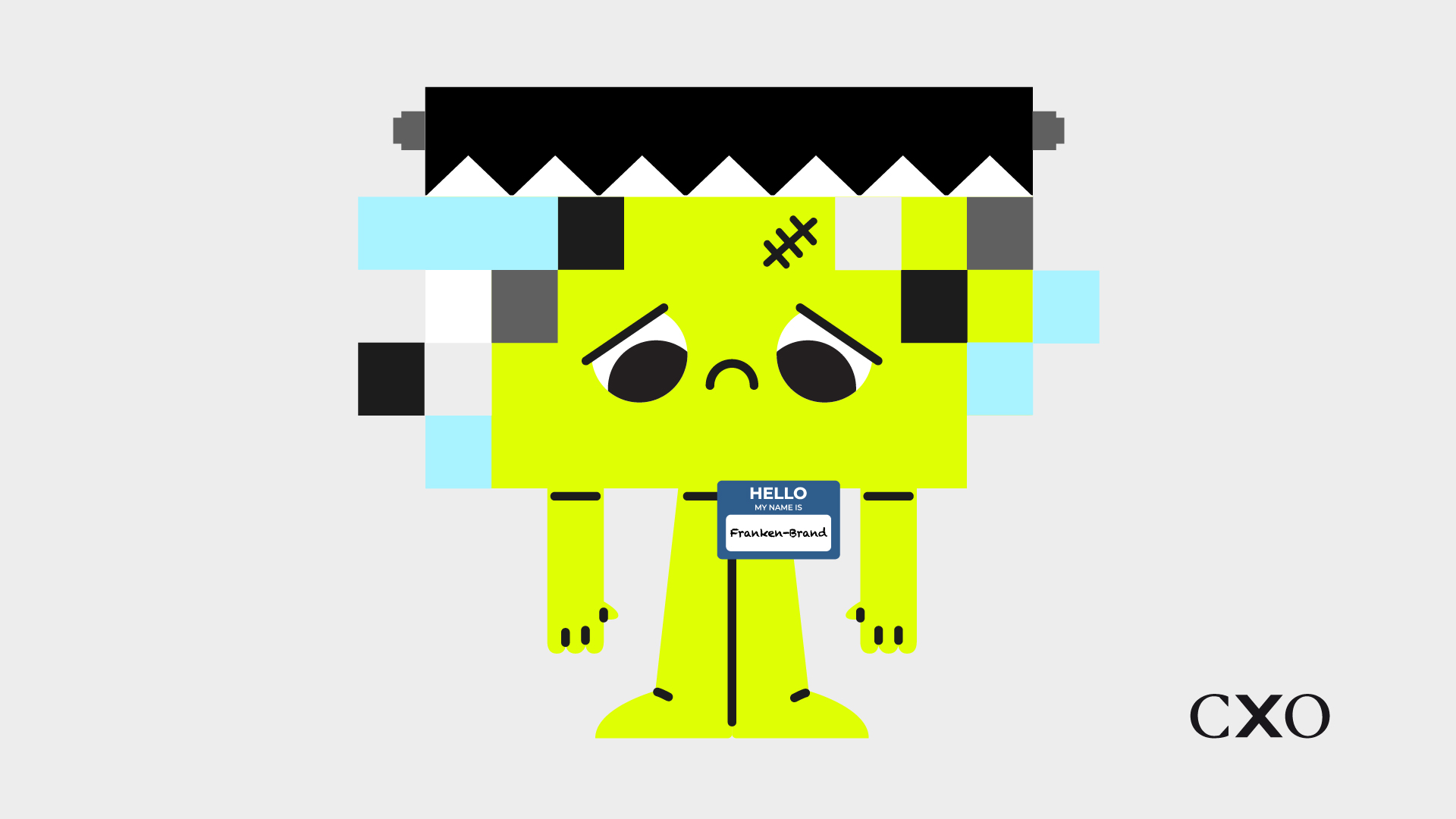
The Road to Franken-Branding is Paved with Good Intentions
Kathleen Bowden Chief Executive Officer
Every well positioned company faces a deceptively simple choice: which brand idea leads – and which ones follow?
In practice, it’s one of the hardest decisions they’ll make.
There is a moment in every brand workshop where we ask the leadership team to take this defining leap.
Which of the 3-4 very different potential brand strategy paths we shared is the right one for their business?
Here’s how this scenario often plays out:
- CEO Naomi and CFO Alan really love the C-Suite DNA of idea #1 as it reinforces their strategic priorities.
- CMO Alyssa believes idea #2 is the most relevant to the big challenges their most important customers are facing.
- CPO Jeff thinks idea #3 sets the perfect stage for the launch of the new products slated to roll out while CHRO Mike loves how it brings their values to life in an unexpected way.
- Everyone is in agreement that idea #4 feels too far from the reality of what they can deliver within the next 18 months. “It’s provocative, but we can’t keep that promise – that one can definitely come off the table.” (Picture heads nodding vigorously).
What comes next you ask?
Yup, some version of this fateful question: “Can’t we just take what we like from ideas 1-3 and create sort of a mash up of the best of the best?”
Sadly, in boardrooms around the world the answer to this question is far too often, “Sure, we can do that.”
This, my friends, is what we at CXO (not so) affectionately call the brand “mush moment.”

No Mushing Zone
Why does this happen?
It happens because bringing a team of executive leaders together around one cohesive brand strategy is very tough.
Yes, executives often have differing views on what brand is, and this does not help.
But the biggest reason things go awry is because inevitably — simmering just under the conference table — are Titanic-sized points of business indecision that have the potential to sink your new brand.
These unresolved questions can include things as essential as:
- Who is our most important customer target?
- How should our product road map be prioritized?
- What is our center of gravity for growth?
When you ask the team grappling with those underlying business issues to make a brand decision that inherently edits out other possibilities, you instantly reveal these gaps.
The truth is that it’s impossible to make hard editing choices about what you don’t want to be when you lack fundamental agreement on what you do want to be.
Franken-Brand Alert
This is a make or break moment.
The worst thing you can do as a brand professional is to let your client’s leadership team feel good that they achieved consensus because you joined three different strategies together with five commas and called it a day.
That’s franken-branding — and it’s negligence to let it happen on your watch.
It creates a brand built on compromise, not conviction.
Instead, you must create the conditions for that leadership team to close any business gaps holding their brand back. Only then will they be able to agree on a singular brand path that creates a clear, compelling market position.
Don’t stop the meeting until you have 90% agreement on that choice.
You can absolutely refine the chosen path to reflect the conversation. But never, ever leave the room with an assignment to “bring the strategies together.”
How the Right Brand Decisions Can Reshape Your Business
Time and time again, we’ve seen our clients’ businesses take new shape in our brand workshops using this approach.
- One successful technology consulting firm came into our workshop with a longstanding internal divide: should they continue prioritizing their traditional VP/Director-level buyers, or make a bold move to serve the C-Suite? We structured the session to surface and resolve that tension head-on. At the end of the workshop, the team made a clear, unified decision to reposition around their C-Suite value. That choice didn’t just shape the brand — it reshaped the business. It became the centerpiece of their strategy and helped position the firm for acquisition by a global professional services powerhouse just two years later.
- In another workshop, a global security company confronted a hard truth: their customers were ready for deeper, more strategic engagements that addressed rising board-level cybersecurity challenges. Our client was failing to walk through that open door, so their competitors were. Grounded in this fresh customer insight, the leadership team made a decisive shift from a product-led to a customer-led strategy. That single decision cascaded across the business — from go-to-market to org structure — including the launch of an entirely new services organization to support the position they chose to own.
How to Stay Out of Brand Jail
Beyond saying a hard no when someone asks you to do the brand “mush,” here are five ways to avoid building your very own franken-brand:
- Double down on customer insight
Soak up all existing brand and customer data but resist the urge to “leverage past research” and forgo new customer insight. No amount of past or related research can replace relevant, timely one-on-one conversations with customers and prospects. This is what gives you the fresh outside-in context you need to break through executive disagreements and ultimately ensure your brand attracts your most important customers. - Get every exec that matters in the room
It can be very tempting to do all the hard work to define the brand strategy and then try to “sell up” your recommendation to the senior team. They are indeed very busy and may even question whether they really need to be in the brand workshop. But executive leaders who have not been a part of the hard editing decisions that go into selecting a brand strategy (and walking away from other possibilities) will never fully understand the connection to the business strategy, feel their fingerprints on it and be personally invested in it. As a result, it will be infinitely harder to get them to greenlight the strategy with conviction and adequate funding. And because they will see it as simply a creative wrapper around the business, they’ll be less inclined to stick with it for any meaningful amount of time. - Assess the competition from a new POV
The executive team thinks a lot about the competition. Who are we coming up against? How does our offering compare? What does their pricing look like? These are all essential considerations to drive the portfolio forward. But in a brand workshop, you have a chance to show the executive team the competition from a different vantage point. What ideas and positions are competitors out there trying to own? Where is the highest-value category white space? This added context will sharpen the urgency and precision with which they make their ultimate brand decision. - Lay out the business implications
Often our clients kid around with us when we present multiple brand ideas for their consideration. They say things like, “We know the middle idea is the one you really want us to choose” or “Which one did you put in here just so we could throw it away?” We laugh as we know this can be a common approach in our field, but then we explain that each brand idea we share is strategically sound. We don’t present it unless we know our client could credibly own it. With that said, some of the ideas are naturally closer to the reality of today. They feel like a comfortable coat. Others would require stretch to own. And others feel more scary and uncomfortable – a big leap from today, but reflective of the leadership team’s vision for the future. While decisions about how the ideas get executed will be creative, this first decision is completely strategic. These are the two biggest questions executive teams should consider as they make this choice: 1) Which of these potential brand strategies best reflects the business strategy and would help accelerate it? and 2) What business commitments would each strategy require to live up to and are we willing to make them? This is how you take a leadership team through a brand decision, shifting from what is often a subjective creative discussion (i.e., I don’t like that word or color) to a true business evaluation. - Show them what they’re deciding
When you engage C-Suite executives in brand decisions, remember that this is not typically their core expertise. They don’t naturally see how a message platform turns into an ad, a LinkedIn post or a press release. You cannot just show a few high-level concept statements and ask them to pick one. Back up each brand strategy idea with specific demonstrations that help everyone clearly understand how each choice would play out in the day-to-day. This might mean mocking up a thought leadership article, creating an “imagine this” tradeshow environment, remaking the website home page to reflect the potential new positioning or crafting a new press release boilerplate for each idea you share. This is an essential step along the way to ensure they know how this new brand idea will really show up and can make a fully informed choice.
Brand decisions are business decisions. And getting them right changes everything.
Learn more about how we help leadership teams get there: Contact us at info@cxocommunication.com today